Blog

  • The Ultimate Guide to Visiting Cai Rang Floating Market

    The Ultimate Guide to Visiting Cai Rang Floating Market

    Cai Rang Floating Market

    There is always something unparalleled and exceptional that can only be found in local markets, most especially a floating one. It’s a tradition that dates back to a couple of decades (or even more), and the continuous usage of it makes it more renowned. Let’s take a step back in time and enter the best floating market in Mekong Delta, Vietnam – the Cai Rang Floating Market. 

    When somebody mentions a floating market, a couple of goods on a boat in a river is probably the last thing that will enter your mind. Besides, why would people go on boats to barter goods if there are markets on land? It all has something to do with the history of the Cai Rang Floating Market. 

    The best floating market in Mekong Delta, Vietnam started as the only means of trade because the roads were, well, there were no roads. And people had to find goods, and so the trading began, on water. The wonderful thing about this is that even after roads were developed, the Cai Rang Floating Market lived on and is now a prominent spot to visit. You can’t go to Vietnam and not experience this. It’s like going to Europe during Christmas and skipping the Christmas markets. Who does that?

    When To Visit

    Rain or shine, no season is daunting to visit the Cai Rang Floating Market. It’s all up to your preference. Going during the rainy season will be cooler, of course. But it also means prepare your rain gear and rent a boat with a roof. It is highly suggested though to visit from late January to early February, the week before the Lunar New Year – this is the busiest week and it won’t be like any other. 

    How To Get There

    Cai Rang Floating Market is in Can Tho, which is about a 4-hour drive from Ho Chi Minh. There is a bus that goes directly from Phuong Trang in District 1. But you can also rent your own transportation and drive. 

    To access the floating market, you’d need to book a boat in Ninh Kieu station. You can choose from big boats with a roof (which is ideal during the rainy season) or you can just hop on a small one (2-4 seater, no roof). 

    See & Do

    You’d be surprised that you can spend more than an hour in the Cai Rang Floating Market and still feel the need to stay longer. After all, it is the best floating market in Mekong Delta, Vietnam. Be sure to be at Ninh Kieu station at around 5 am in the morning, so you wouldn’t miss the busiest time of the floating market, which is anywhere from 6 am until noon. It takes about 30 minutes by boat (from Ninh Kieu) to reach the actual market spot.

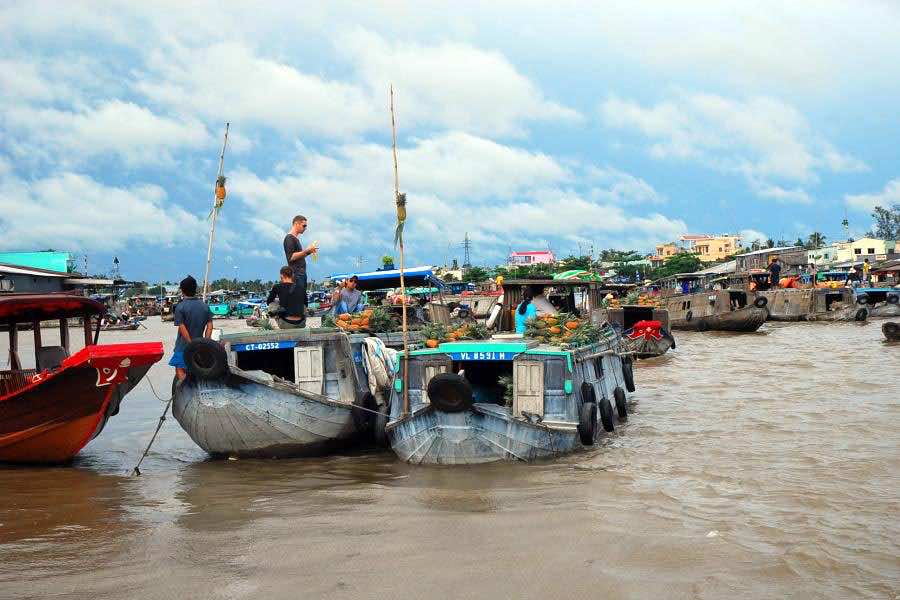
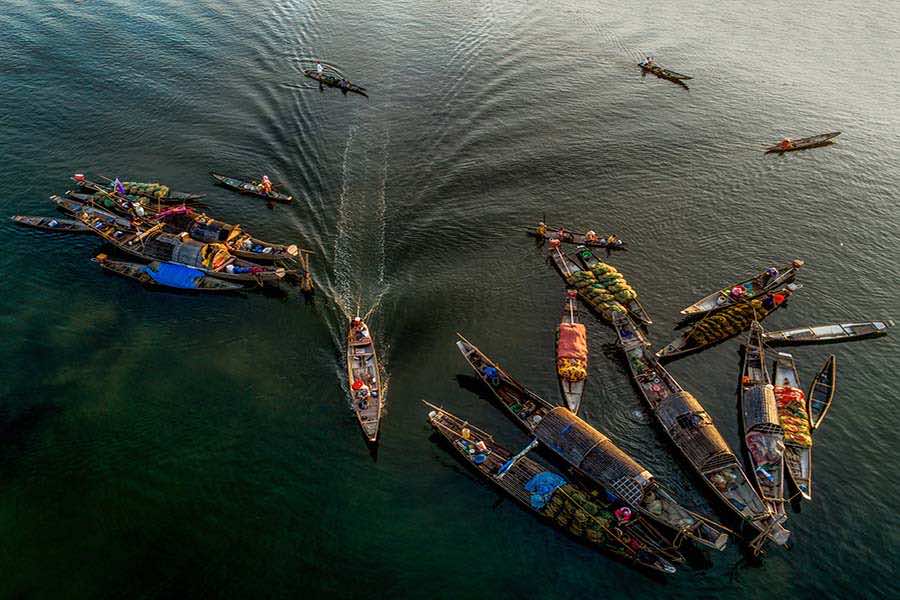
    When you arrive at the scene, you’d be overwhelmed by the variety of fresh produce that each boat contains. The trick is, if you’re not buying wholesale, the sellers usually hang on bamboo poles what items they sell per piece. So you wouldn’t have to stop each boat to ask and it’s easy to see when they’re hanging. 

    And it’s not just fresh produce that is being sold onboard boats, name it, they have it. From petrol filling boats to food selling boats (and we’re talking about freshly made and just cooked food) – you can find it here. It’s like a living and breathing city on water. You have boats that sell lottery tickets, and everyday items like toothbrushes, plates, etc. 

    What’s amusing is that some, if not most, of the sellers actually live on their boats. You will often see a couple of clothes or blankets hanging on the side of their boats. But unless you see these hanging on the bamboo poles, those are personal belongings and not for sale. 

    If by any chance, you do tire of going to the Cai Rang Floating Market, there are a few museums worth checking out. The Can Tho Museum, Military Museum, and the Khmer Museum. There is also the Phat Hoc Pagoda, which is the main worship center in Can Tho.

    Or you can always continue on the Mekong Delta with our tour option. There’s a fruit garden to visit further along the banks and on the way back to Can Tho will be a lot of rural scenery and lush vegetation. 

    Stay

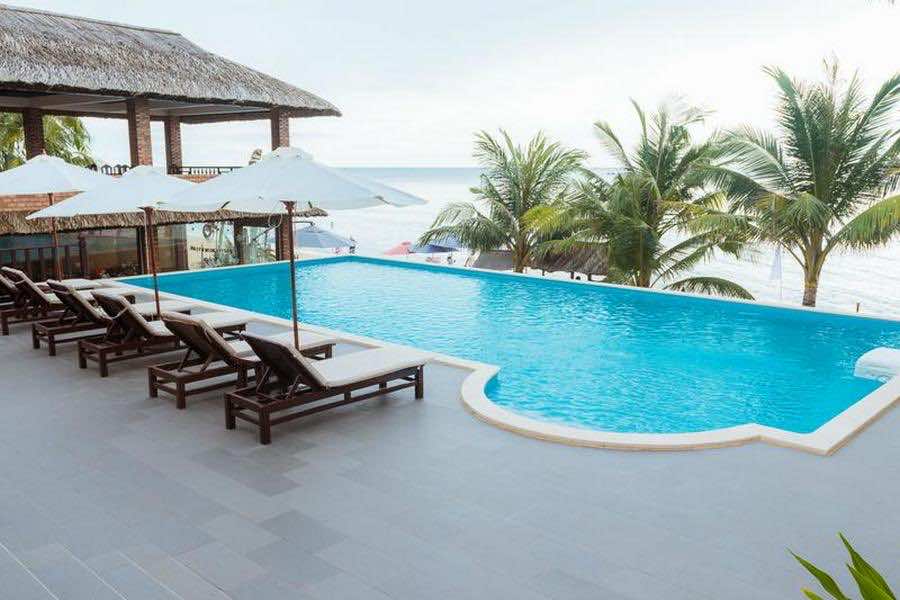
    There are a lot of places to stay in Can Tho, ranging from rustic to boutique to resort and luxury. Mekong Rustic ($46), as its name suggests, gives off the rustic vibe without letting go of comfort. You have bungalows with open-air showers, isn’t that fun. A little bit on the romantic yet modern vibe is TTC Hotel Premium ($82). If you want rustic meets colonial French architecture, Nam Bộ Boutique Hotel ($120) is for you. Victoria Can Tho Resort is a 4-star resort, so expect it to be pricey at $167, but with complete amenities. If you do want to go above and beyond, stay at the Azerai Can Tho Resort ($217), it can only be reached by boat, which makes it exclusive and of course, 5-star. Most of the 4-star to 5-star hotels in this area will offer great rooftop views, if not a pool, so you can relax after that early morning Cai Rang Floating Market escapade. 

    Eat & Drink

    Miss Di Hai noodle soup, which was notably called the best Pho by celebrity and Michelin chef Gordon Ramsay, can only be found in the Cai Rang Floating Market. So don’t miss this. Eat your heart out. Aside from Pho, all kinds of Vietnamese food & drinks (especially their great coffee) can be found in the floating market. So you actually do shopping, sight-seeing, boating, and eating in one go. Nothing gets better than that. 

    If you do need to eat when you’re not in the Cai Rang Floating Market, there are lots of good options in Can Tho. Phuong Nam Restaurant and Nem nuong Thanh Van are good for local cuisine, L’Escale which is on the top floor of Nam Bo Boutique hotel offers really good French cuisine, and Tomato – Pad Thai is highly acclaimed. When in Vietnam, the best-tasting food is can be found in simple places, which could be a random food stall on the street or in the floating market. 

    It won’t be called the best floating market in Mekong Delta, Vietnam if it didn’t offer you everything that you’re looking for. But every place has its ups and downs, even the Cai Rang Floating Market. So when you visit, keep an open mind, expect the unexpected, and as always, let go and enjoy. No trip is perfect, but all adventures can be. 

  • All information you must prepare before traveling to Vietnam

    All information you must prepare before traveling to Vietnam

    We would like to suggest you with some following things that should be ready or to bring on your trip when traveling to Vietnam. To update information with your exactly departure dates, please do not hesitate to contact us at info@absolutetravel.asia or support phone (+84) 24 3927 6076.

    Country codes for international phone call
    Vietnam +84

    Time zones
    Vietnam operates on Greenwich meantime +7 hours, so at 12:00 midday in Vietnam, it will be 05:00am in London; 00:00 am (midnight) in New York; 23:00 (the previous day) in Chicago; 21:00 (the previous day) in Los Angeles. Please note that Vietnam does not have daylight saving hours.

    Internet
    Wireless (wi-fi) Internet access is available in most hotels throughout Vietnam, and most bars, restaurants and cafes in Hanoi and Ho Chi Minh City free of charge.

    Electricity
    Most of the electrical current in Vietnam is 220V, 50Hz. Round two-plug pins are more common although some places use fl at pins or three-pronged pins. Cheap adaptors are sold in local markets. In all countries protect sensitive electronic equipment like laptops from power fluctuations by using a surge-protector.

    Clothing
    If your trip to Vietnam includes stops at beaches and mountainous areas, you will need clothes for all temperatures. A swimsuit, sunglasses, a hat, t-shirts, shorts that are not too revealing, long trousers, some light-weight, long-sleeved tops and a light jacket that is wind and rain-resistant will get you through most trips. If you plan to visit northern Vietnam in the winter, you’ll need a warm coat. Mountainous areas can get chilly; choose clothes you can layer.

    If trekking is on your agenda, you will need sturdy footwear—plus lots of socks. Slip-on shoes or sandals are useful for visits to pagodas or people’s houses, as you’ll save time taking your shoes on and off. Larger cities like Ho Chi Minh City and Hanoi offer upscale bars and restaurants, so be sure to pack some clothes and shoes for a nice evening out. Leave your flashy jewellery at home.

    Toiletries and Medication
    While imported beauty products are readily available in major cities, you’d be wise to pack staples like sunscreen, contact lens solution, tampons and mosquito repellent, as well as prescription medication. Many medicines are available in Indochina without prescriptions, but they may be out-of-date or of poor quality.

    Travel Documents
    You should bring a money belt to safely carry your travel documents and cash, and ensure that your luggage has a lock. Bring photo copies of your passport and visa, plus some extra passport-sized photos if you’re applying for on-arrival visas. When flying into or within Vietnam, you will probably be given baggage claim tags (they will be stuck to the back of your ticket). Keep these, as you will need to show them when leaving the airport.

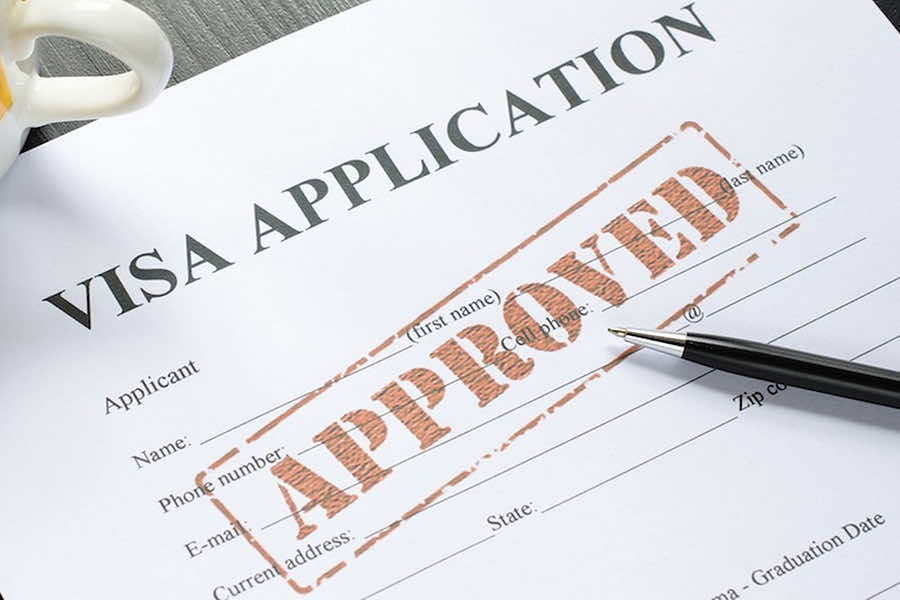
    how to apply visa to vietnam

    Read books
    Reading materials may be hard to find, especially in less-touristy areas, so bring some good books. While cheap, counterfeit CDs are tempting, remember that you may face trouble when you bring these illegal copies home.

    Photography
    Film is sold in bigger tourist centers, although it may be out-of-date or sun-damaged. Stock up in Bangkok or bring it from home. For peace of mind, skip the cut-price, back-alley photo shops and get your precious pictures developed some places you trust.

    Good manners
    In Vietnam, revealing clothing is unacceptable off the beach. Shorts are generally fine – as long as they aren’t too short. People tend to dress as well as they can afford to – Vietnamese people are often astonished by some travelers’ choice of dirty and tattered clothing.

    When visiting pagodas, temples or Ho Chi Minh’s Mausoleum in Hanoi, shorts and tank-tops are unacceptable (no camera allowed inside HCM Mausoleum). Your knees and shoulders must be covered. Footwear and socks must be removed in pagodas. Shoes are usually removed upon entering private homes too.

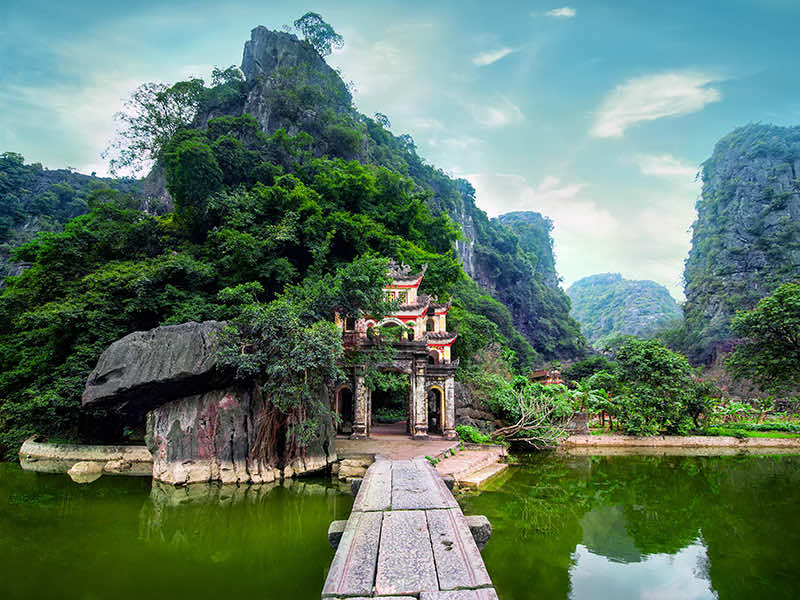
    NIINH BINH BICH DONG PAGODA

    In terms of behavior, public displays of affection between men and women are considered shocking. On the other hand, it’s perfectly normal for a pair of men or a pair of women to link arms or hold hands. Upon meeting someone new, people may simply nod to each other or may shake hands. Using both hands to shake someone’s hand is a warm gesture of respect.

    Beckoning someone by crooking your finger is very rude. The correct way to call someone over is to extend your hand with the palm down and flap your fingers towards your wrist. To ask for the bill in a restaurant or shop, extend one hand in front of you with the palm raised and pretend to write on your palm with the other hand.

    The majority of men in Vietnam smoke. While flights are non-smoking, very few restaurants or bars offer non-smoking seating.

    Airport arrivals
    Please look for the welcome sign outside of Exit with your name and our company logo on it, and your guide/driver will lead you to the car.

    Airport security
    Please be aware that our courtesy check-in service is now limited due to the current world security climate. Some airports will stipulate that you must check in your own bags. We thank you for your understanding on this matter.

    Luggage allowance
    The Excess baggage is charged at a certain amount depending on the individual route and the price is subject to change

    VIETNAM AIRLINES
    Economy: 23kg checked (1 piece only), 1 x 10kg cabin baggage
    Business: 30kg checked, 2 pieces weighing not more than 7kg cabin baggage
    Excess baggage charge: US$1.5 per kg for domestic flights and US$3-5
    per kg for international flights.

    BANGKOK AIRWAYS (no business class available)
    Checked baggage – 20kg per person
    Cabin baggage – 5kg
    Excess baggage charge: US$2-5 per kg

    SINGAPORE AIRLINES
    Economy: 20kg checked, 7kg cabin baggage
    Business: 30kg checked, 7kg cabin baggage
    Excess baggage charge: US$7- 10 per kg

    THAI AIRWAYS
    Economy – 20kg checked,
    Royal Executive Class – 30kg checked
    Royal First Class – 40kg checked
    All classes are permitted 7kg cabin baggage
    Excess baggage charge: US$5 per kg

    Departure tax
    Airport tax for both domestic and international flights is included in the ticket price from Hanoi, Danang, and Saigon airports.

    Travel insurance
    Trip insurance is highly recommended and please contact :
    www.travelexinsurance.com for further information. Nobody should travel abroad without travel insurance that covers emergency medical evacuation, hospital costs and repatriation. You may also wish to purchase a policy to cover lost and stolen belongings. We also advise that you check carefully policies for trip insurance before purchasing in the event of a cancellation or change to the itinerary, either for personal reasons or due to local events (e.g. adverse weather conditions, flight delay) the extra costs are covered.

    Shopping & shipping
    Vietnam is still developing, and so its people can be very persistent when trying to make money, especially around tourists whom they perceive as very wealthy. People will try to overcharge you, but rather than becoming irritated, join the game and bargain hard! It is also recommendable to check prices of the same items in the neighborhood before reaching a deal.

    If you being followed by street vendors and do not wish to make a purchase, often the best course of action is say “no” firmly and politely, and continue on your way. Do not hesitate or linger, as this will encourage the seller to try and engage you further.

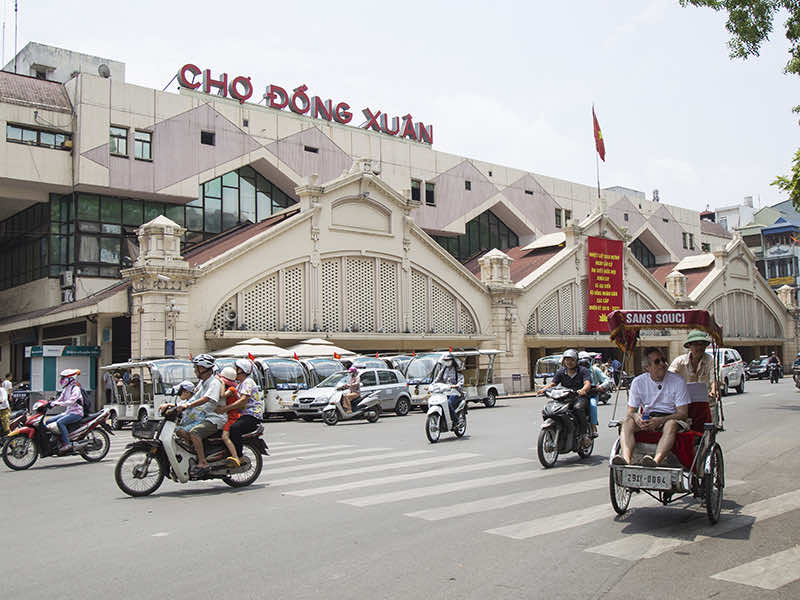
    HANOI DONG XUAN MARKET

    If you choose to ship items home, we highly recommend that you buy shipping insurance and check the policy details. As shops are not responsible for damages incurred en route, it’s better to be safe than sorry.

    Touring Vietnam cannot accept responsibility for any misrepresented or faulty goods. We do not take responsibility for following up on merchandise that you choose to ship home.

  • Laos Visa & Entry Rules for Indian Travelers 2026

    Laos Visa & Entry Rules for Indian Travelers 2026

    Laos in 2026: What Indian Travel Trade Partners Need to Know About Entry Rules

    Laos is fully open and remains one of the most peaceful, underrated destinations in our region. For Indian clients looking for something different from the standard Vietnam or Thailand trip, the UNESCO town of Luang Prabang, the Mekong river towns, and the temples of Vientiane offer a genuinely fresh story to sell.

    The COVID rules from a few years back are all gone. No testing, no vaccine proof, no special insurance, no quarantine. But Laos has tightened its border process in other ways since September 2025, and there is one new requirement that catches travelers out if their agent doesn’t brief them. Let me walk you through what is current.

    1. Visa Options for Indian Passport Holders

    Indian nationals need a visa to enter Laos. Three practical routes:

    1. E-Visa (recommended for almost all clients). Apply online at laoevisa.gov.la. Processing takes around 3 working days. Cost is around USD 35 to USD 50, valid for a 30-day single-entry stay. The e-visa can be used at 9 international entry ports. Cleanest option for almost any planned trip.
    2. Visa on Arrival (VOA). Available at major international airports and main land borders. Indian clients pay around USD 40 to USD 50 in cash, plus they need 2 passport photos (50mm x 50mm) and proof of onward travel. Useful as a backup, but I would not recommend it as the default. Queues at land borders like the Thai-Lao Friendship Bridge can be slow, and there are small “overtime” fees outside office hours and on weekends.
    3. Embassy sticker visa. Available at the Lao Embassy in New Delhi or the consulate in Mumbai. Mostly relevant for long stays, business categories, or cases that need a multiple-entry arrangement.

    Passport must have at least 6 months validity and 2 blank pages. This is non-negotiable at the counter.

    2. The New Lao Digital Immigration Form (LDIF). Mandatory.

    This is the most important update for the trade to know. Many agents are still briefing clients on the old paper arrival/departure card. Stop doing that.

    From September 1, 2025, Laos launched the Digital Arrival and Departure Cards to replace the paper forms. All travelers entering or leaving Laos must complete arrival and departure documents online and in advance.

    The four entry points currently enforcing this are:

    1. Wattay International Airport, Vientiane
    2. Luang Prabang International Airport, Luang Prabang
    3. Pakse International Airport, Pakse
    4. First Lao-Thai Friendship Bridge, Vientiane

    The procedure is free. Travelers fill in personal details, passport information, visa details, and their first address in Laos, upload a passport copy and a selfie with passport, and receive a QR code to present at immigration. Submit 2 to 3 days before arrival and keep a printed backup.

    Two practical points for your trade:

    1. The LDIF is separate from the visa. Your clients still need their e-visa or VOA approval. The LDIF does not replace either.
    2. Be cautious of copycat websites charging USD 20 or more for what is a free government form. The only legitimate portal is the official Lao immigration site. Send your clients the direct link.

    3. Visa Extension and Practical Notes

    If your client wants to extend, a visa extension is possible once for 30 days, at 20,000 kip per day. For longer or multiple-entry stays, the embassy route is usually cleaner than extending on the ground.

    A few other things worth telling your clients before they fly:

    1. Carry cash in USD or Thai Baht for VOA fees and small purchases. The Lao Kip (LAK) is the local currency and ATMs work in major towns, but rural areas are cash-only.
    2. Dress modestly when visiting temples. Luang Prabang is a UNESCO town and the etiquette around the Tak Bat alms-giving ceremony at dawn is taken seriously by locals.
    3. Internal travel in Laos is slow. Build buffer time into the itinerary. Road conditions and limited domestic flight options mean a 200km journey can take half a day.

    4. What This Means for Your Trade Practice

    A few honest recommendations:

    1. Default to the e-visa for any client flying into Vientiane, Luang Prabang, or Pakse. It is the most predictable route.
    2. Always include the LDIF step in your booking confirmation and pre-departure email. Treat it the same way you treat the Vietnam Digital Arrival Card.
    3. For combined Vietnam-Laos itineraries (a common Indian leisure request), brief your clients that they need two separate visas, two separate arrival cards, and two separate sets of paperwork. The two countries do not share systems.
    4. For overland border crossings from Vietnam or Thailand into Laos, plan the crossing early in the day and have the e-visa already approved. Land border surprises are the most common reason a Laos trip starts badly.

    At Absolute Asia Travel, we handle the full Laos logistics chain from visa support to arrival card guidance to ground operations. If you have a Laos-only or multi-country booking and want us to take the paperwork load off your sales team, just send us the passenger list and we will sort the routing.

  • Cambodia Visa & Entry Rules for Indian Travelers 2026

    Cambodia Visa & Entry Rules for Indian Travelers 2026

    Cambodia in 2026: What Indian Travel Trade Partners Need to Know About Entry Rules

    Cambodia is fully open and quietly becoming one of the most rewarding additions to an Indian client’s Indochina itinerary. Angkor at sunrise is still the headline act, but the new airport at Siem Reap, smoother visa logistics, and a much simpler arrival process mean the operational risk of booking Cambodia has dropped significantly since the COVID era.

    All the old pandemic rules are gone. No testing, no vaccine proof, no special insurance, no quarantine. What you do need to brief your clients on is the visa, and a new mandatory arrival form that many agents are still missing.

    1. Visa Options for Indian Passport Holders

    Indian nationals need a visa to enter Cambodia. Three practical routes:

    1. E-Visa (recommended for almost all clients). Apply online at the official portal, evisa.gov.kh. Cost is USD 36, processing takes 3 business days. The visa is valid for 3 months (90 days) from the date of issue, with a permitted stay of up to 30 days from entry. The e-visa is supported at three airports and four land borders: Phnom Penh International (PNH), Siem Reap Angkor International (SAI), Sihanoukville International (KOS), and the land crossings at Cham Yeam, Poi Pet, Bavet, and Tropaeng Kreal. This is the cleanest option for any planned trip.
    2. Visa on Arrival (VOA). Indian passport holders can obtain a visa on arrival at Phnom Penh, Siem Reap, and Sihanoukville international airports, as well as at selected land border crossings. The fee is USD 30, payable in cash. Card payments are not accepted at the VOA counter. Useful as a backup, but the e-visa is more predictable.
    3. Embassy sticker visa. Available at the Royal Embassy of Cambodia in New Delhi. Mostly relevant for business, work, or longer stay categories that need extension flexibility.

    Passport must have at least 6 months validity and 2 blank pages.

    2. The New Cambodia e-Arrival Card. Mandatory for All Air Arrivals.

    This is the most important update for the trade to know, and it is the single biggest reason Indian travelers get delayed at Cambodian airports in 2026.

    Cambodia’s digital e-Arrival Card became mandatory on September 1, 2024, for all air travelers arriving at Phnom Penh, Siem Reap, or Sihanoukville airports. The free online form replaces paper immigration, health, and customs declarations and must be completed within seven days before arrival at arrival.gov.kh or via the Cambodia e-Arrival app. Travelers receive a QR code to present at immigration alongside their passport. The requirement applies regardless of visa status or nationality, including visa-exempt travelers and those with pre-approved e-visas.

    What this means in practice:

    1. The e-Arrival Card is one form that combines what used to be three separate paper forms: immigration, health declaration, and customs.
    2. It is free. The only legitimate portal is arrival.gov.kh or the official Cambodia e-Arrival app on iOS and Android.
    3. Submit within 7 days before arrival. Save the QR code on the phone and keep a printed backup.
    4. Children need separate submissions. There is no family group option yet, so each passenger in your booking needs an individual form.
    5. Land border crossings into Cambodia from Thailand, Laos, or Vietnam still use paper forms. But fly-in arrivals are 100% digital now.

    A practical warning for your trade desk: third-party websites are charging USD 20 to 50 for what is a free government form. Make sure your clients use the official portal only. Add the correct link to your booking confirmation template.

    3. Practical Notes for Your Indian Clients

    A few things worth telling your clients before they fly:

    1. The new Siem Reap-Angkor International Airport (SAI) is now the main gateway to Angkor. It opened in late 2023 and is around 40 minutes by road from the temples. The old REP airport is closed for commercial flights. Update any old itinerary references.
    2. Cambodia uses two currencies in daily life: US Dollars for almost everything, and Cambodian Riel for small change. Indian clients should carry USD in small denominations. Cards are accepted in hotels and bigger restaurants in Siem Reap and Phnom Penh, but rural and temple areas are cash-only.
    3. Angkor Pass costs are paid separately on arrival at the ticket office: USD 37 for one day, USD 62 for three days, USD 72 for one week. Cards accepted. Photo taken on site.
    4. Dress code at Angkor and the Royal Palace is strict. Shoulders and knees must be covered. Sarees are fine. Sleeveless tops, short skirts, and shorts above the knee will be refused at temple entry.

    4. What This Means for Your Trade Practice

    For Indian agents booking Cambodia, here is the operational checklist:

    1. Default to the e-visa for any client flying into Phnom Penh, Siem Reap, or Sihanoukville. USD 36, 3 days, done.
    2. Always include the e-Arrival Card link in your pre-departure email. Treat it the same way you treat the Vietnam Digital Arrival Card and the Laos LDIF. Three countries, three separate digital forms.
    3. For combined Indochina itineraries (Vietnam-Cambodia-Laos), brief your clients clearly that they need three separate visas and three separate arrival cards. The countries do not share systems.
    4. For overland border crossings into Cambodia from Thailand or Vietnam, paper forms still apply at the land checkpoints. Have the e-visa pre-approved.

    At Absolute Asia Travel, we run direct ground operations in Cambodia from our partner DMC base, covering Siem Reap, Phnom Penh, the southern coast, and the temple circuits beyond Angkor. We handle visa support, arrival card guidance, and full ground logistics for our B2B partners. If you have a Cambodia-only or Indochina multi-country booking, send us the passenger list and we will sort the documentation routing.

  • Entry Requirements for Vietnam (Updated June 2026)

    Entry Requirements for Vietnam (Updated June 2026)

    Vietnam Entry Rules for Indians 2026: E-Visa, Phu Quoc & New Forms

    Vietnam is fully open, and frankly, it has never been easier for your Indian clients to come and visit. The COVID rules are long gone. No quarantine, no testing, no vaccine proof, no health insurance minimum. What replaces them is a much simpler set of immigration requirements, plus two new pre-arrival forms that your clients need to complete online before they board the plane.

    Here is the current picture, straight from the front line.

    1. Visa Options for Indian Passport Holders

    Indian nationals are not on Vietnam’s visa exemption list for the mainland. Travelers heading to Hanoi, Ho Chi Minh City, Da Nang, Hoi An, or Ha Long Bay need a valid visa, no exceptions. You have three practical routes:

    1. E-Visa (recommended for almost all leisure clients).
      The e-visa has been available to Indian citizens since August 15, 2023, with validity extended to 90 days and a choice of single or multiple entry. It is applied for entirely online, no embassy visit required, and accepted at 83 international entry and exit points. The government fee is USD 25 for single entry, USD 50 for multiple entry. Processing time is 3 to 5 working days. Apply through the official portal at evisa.gov.vn. Tell your clients to apply at least 7 to 10 days before departure, especially during Tet and peak season.
    2. Visa on Arrival (VOA).
      Available at international airports only, not at land or sea borders. Requires a pre-approval letter arranged through an agent before flying. Useful only when the e-visa system is down or there is a last-minute booking. For most cases, the e-visa is cleaner and cheaper.
    3. Embassy sticker visa.
      Available at the Vietnamese Embassy in New Delhi. Mostly relevant for long stays, business visas with extensions, or family visit cases that don’t fit the online system neatly.

    Passport must have at least 6 months validity beyond arrival and 2 blank pages.

    2. The Phu Quoc Visa-Free Exception (Read This Carefully)

    This is the one piece of Vietnam visa policy that catches the most Indian travelers out, and I want to be direct with you because the consequences are real.

    Phu Quoc Island offers a 30-day visa exemption for Indian nationals. It is the only place in Vietnam where this applies. But every single condition below must be met at the same time, with no exceptions:

    1. Direct international arrival into Phu Quoc International Airport or Seaport from another country
    2. Stay only on Phu Quoc Island for the duration of the trip
    3. Direct international departure from Phu Quoc to another country
    4. Passport valid for at least 6 months
    5. Confirmed onward or return ticket

    Flying into Ho Chi Minh City or Hanoi first and then taking a domestic connection to Phu Quoc does not qualify. No mainland stopover. No day trip to Ho Chi Minh City. If your client lands in HCMC first, the exemption is void and they need a proper visa.

    On April 6, 2026, the Indian Embassy in Hanoi issued a travel advisory specifically warning Indian travelers about Phu Quoc visa rules and passport risks. The embassy flagged two main issues. First, the “visa trap”: if a client enters Phu Quoc visa-free and then needs to reach the mainland for a medical emergency or any other reason, they cannot legally do so without a valid visa. There have been actual cases of Indian travelers needing hospital treatment in Ho Chi Minh City and facing immigration delays. Second, passport loss creates serious complications when the holder is on a visa-free entry.

    My honest recommendation for your trade: unless the client genuinely wants only a beach holiday on Phu Quoc with no mainland touch, apply for the 90-day e-visa anyway. It costs USD 25, takes 3 days, and removes every single one of these risks. The savings on the visa fee are not worth the operational headache if anything goes wrong on the ground.

    3. Two New Pre-Arrival Requirements You Must Brief Your Clients On

    These are new in 2026 and many agents are still not aware. Both are free, both are online, and both are mandatory.

    Digital Arrival Card.
    As of April 15, 2026, this is a mandatory electronic declaration required for entry through Tan Son Nhat International Airport (SGN) in Ho Chi Minh City. As of June 2026, the requirement has expanded to Noi Bai International Airport (HAN) in Hanoi. Da Nang and land and sea border gates are next in line, though no official date has been confirmed. The form must be submitted within 72 hours before arrival at prearrival.immigration.gov.vn. It generates a QR code that immigration officers scan at the counter. The form is free. Be cautious about copycat websites charging USD 20 to 50 for what is a free government service.

    Health Declaration under Decree 165/2026/ND-CP.
    From July 1, 2026, a mandatory health declaration applies to all travelers crossing any Vietnamese border, in any direction, at any port. It must be submitted within 7 days before entry, exit, or transit. The declaration is separate from the Digital Arrival Card and is managed by the Ministry of Health, not Immigration. It can be submitted online or on paper using Appendix V of the decree, with paper forms available from airlines and at border gates.

    So a client arriving in Ho Chi Minh City or Hanoi from July 1, 2026 onwards needs all of the following: a valid e-visa, the Digital Arrival Card (within 72 hours of arrival), and the Health Declaration (within 7 days of arrival). All three are separate.

    4. What This Means for Your Trade Practice

    A few practical points for B2B partners:

    1. Add a visa and pre-arrival checklist to every Vietnam booking confirmation you send Indian clients. Three items, all free: e-visa, Digital Arrival Card, Health Declaration.
    2. Default to the 90-day e-visa for any client touching mainland Vietnam. Skip the Phu Quoc exemption unless the client is genuinely doing an island-only trip.
    3. Remind clients to keep a printed and digital copy of the e-visa approval, the Digital Arrival Card QR code, and the Health Declaration confirmation. Immigration counters at SGN and HAN move faster when documents are ready.
    4. Brief your clients on passport rules: 6 months validity, 2 blank pages, and immediate police report if lost in Vietnam.

    We at Absolute Asia Travel handle all of this for you. From visa support to airport assistance, our DMC team in Hanoi takes care of the documentation logistics so your sales team can stay focused on selling the trip.

    If you have a complex case or a group with mixed nationalities, just send us the passenger list and we will sort out the visa pathways before you quote the trip.

  • Halong Bay, Bai Tu Long Bay or Lan Ha Bay

    Halong Bay, Bai Tu Long Bay or Lan Ha Bay

    We all have heard of Halong Bay and constantly ticked it for our must-go destinations. What most people don’t know is that Halong Bay is not the only gorgeous one in the area. There are 3 of them. And they all shine in their own nuances and are unmistakable. Let’s take a closer look to see how well you know one of the most beautiful places on earth, as well as what it is still hiding from the world?

    Halong Bay – The Graceful Muse

    Halong Bay Vietnam 3 1
    Halong Bay Limestone Mountain

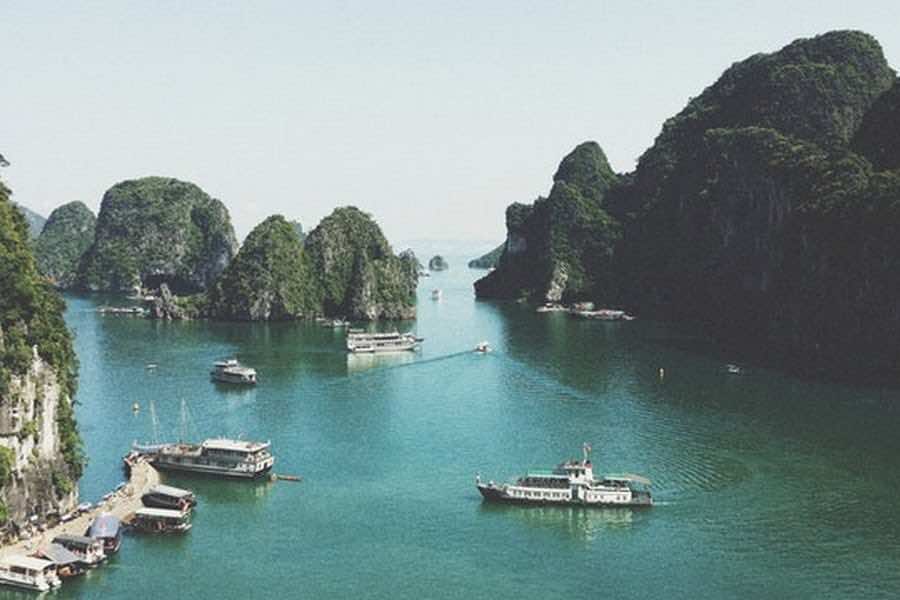
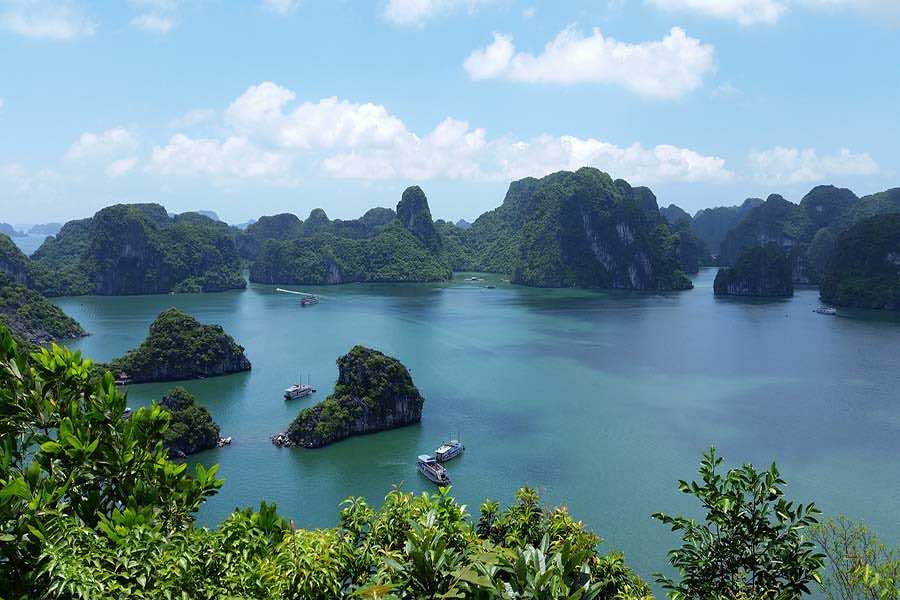
    Needless to mention the reputation of this world nature wonder, Halong Bay becomes busier than ever as its beauty really stood the test of the time. Hence, be prepared for the huge amounts of visitors here. However, it’s fair to say that Halong Bay owns the unique gracefulness which can make up to anything that might be your concern.

    This is the most extensive area of limestone mountains which made the signature of Halong Bay. With every changes of the time during the day, the light gently touches the mountains to create a colorful orchestra of the nature. Staying in this bay always leaves you in awe of the contrast between a small human-being and the great Mother Nature. Apart from that, Halong Bay features the largest and most beautiful caves of 3 bays. Not directly facing the ocean like its neighboring bays, this is the safest spot to swim with minimum effect of ocean currents and the warmer water.

    This part of the complex basically has it all. Whether you are a sport lover or a nature appreciator, there’s a range of activities at your disposals such as sightseeing, canoeing, kayaking or fishing…

    The blessing scenery has been attracting a lot of foreign film makers to come and create masterpieces, the most famous ones are Indochine (1992) and Kong: Skull Island (2017). Many Vietnamese artists also come to Halong Bay to nurture their senses of art. Don’t miss your chance on this.

    For sightseeing:

    Ti Top Island (Titov Island)

    Surprise Cave

    Three Peaches Beach (Ba Trai Dao Beach)

    Soi Sim Beach

    Luon Cave

    Tuan Chau Beach

    … and so on.

    Activities:

    Kayaking

    Swimming

    Cave visit

    Visiting a fishing village by sampan

    Fishing from the boat

    Cooking demonstration

    Cruises go to Halong Bay:

    Aclass Legend Cruise

    Glory Legend Cruise

    Pelican Cruises

    Paradise Cruises

    Bhaya Cruises

    Legend Cruises

    Au Co Cruises

    Indochina Sails

    Valentine Cruises

    Jasmine Cruises

    Violet Cruises

    Embarkation & Disembarkation Points: Tuan Chau Pier

    Bai Tu Long Bay – The Diamond In The Rough

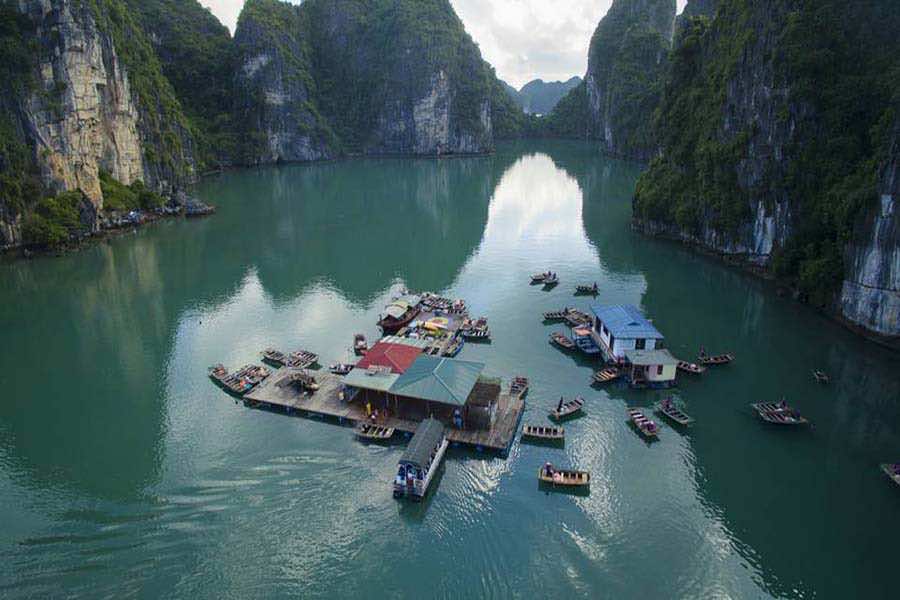
    Vung Vieng fishing village
    Vung Vieng Fishing Village

    If the crowd is a problem for you, Bai Tu Long Bay is a more peaceful yet magnificent area in this complex. When it comes to comparisons, this bay almost has everything its renowned sister offers except for less tourists. In short, it’s a laid-back alternative to the bustle of Halong Bay. Boasting the same spectacular scenery of islands, karst pinnacles and the caves, there are plenty of activities for you to enjoy here from trekking, rock climbing to taking a dip in some secluded beaches or just purely treasuring the nature beauty. In addition, it’s the only bay which is home to one of seven Vietnamese national parks. For all nature lovers: don’t miss a chance to pay a visit to Bai Tu Long National Park which features both a terrestrial and an aquatic zone to cherish the pristine and flourishing wildlife here as it’s under strict protection.

    Bai Tu Long Bay offers a closer look into the local community since tourism is still in the initial stage here. You’ll have the chance to meet local people, not just sellers, owners or staff on the cruises but the Vietnamese.

    For sightseeing:

    Cap La Island

    Hon Co Island

    Bai Tu Long National Park

    Thien Canh Son Cave

    Vung Vieng Fishing Village

    … and so on.

    Activities:

    Kayaking

    Visiting a fishing village by sampan

    Cave visit

    Fishing from the boat

    Cooking demonstration

    BBQ on private beach (with Indochina Junk fleet)

    Cruises go to Bai Tu Long Bay:

    Dragon Pearl Junk Cruises

    Red Dragon Cruises

    L’Amour Cruises

    Prince Cruises

    Dragon Legend Cruise

    Swan Cruise

    Paloma Cruises

    Huong Hai Sealife Cruises

    Emperor Cruise

    Signature Cruises

    Embarkation & Disembarkation Points: Hon Gai Pier

    Lan Ha Bay – The Hidden Gem

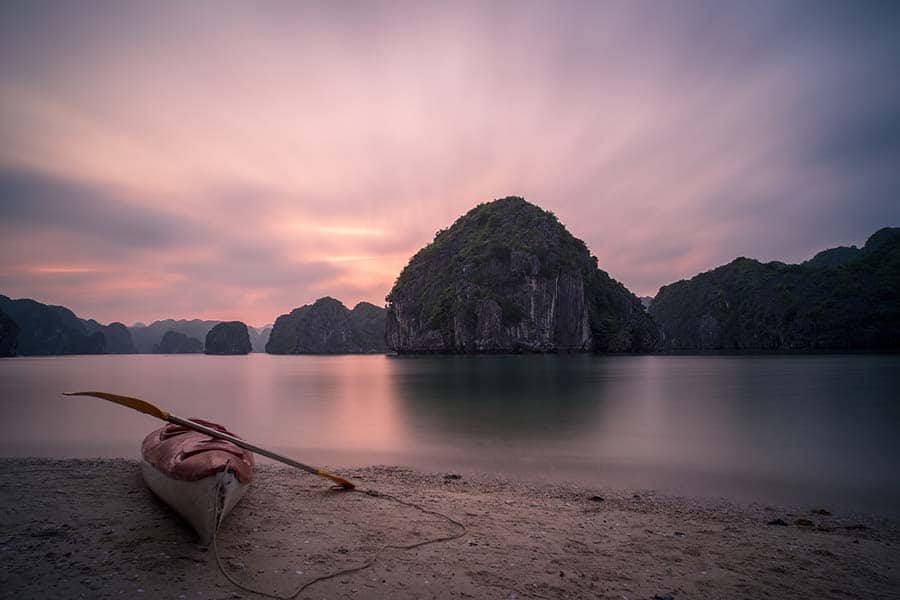
    Peaceful sunset in lan ha bay
    Peaceful Sunset at Lan Ha Bay

    Situated in the south of the Halong Bay and the east of Cat Ba Island, Lan Ha Bay humbly shines in its own beauty which is no less than Halong itself. Being the smallest one out of the 3 well-known bays, 400 of the karst formations were covered by greeneries and elegantly rest in the emerald waters. It earned the title as “Kayaking Paradise” for allowing travelers to paddle through plenty of caves and around the area. 139 sandy beaches are modest in sizes which makes them perfect for swimming, chilling out or even snorkeling to see coral reefs in some of them. Other than that, there is a splendid cycling route to Cat Ba National Park for visiting Viet Hai fishing village.

    This is an ideal spot to spoil your adrenaline thirst by trying out some trekking, deep water bouldering, and rock climbing. We highly recommend this bay for adventurous travelers who also want to have a sense of the world nature wonder.

    For sightseeing:

    Viet Hai Fishing Village

    Trung Trang Cave

    Cai Beo Floating Village

    Activities:

    Kayaking

    Swimming

    Cycling the island road

    Village visit

    Fishing from the boat

    Cooking demonstration

    Which cruises go to Lan Ha Bay:

    V’spirit Premier Cruises

    Perla Dawn Cruise

    Stellar of the Seas Cruise

    Orchid Cruises

    Ginger Cruise

    Ylang Cruises

    Embarkation & Disembarkation Points: Got Pier

    When you’re considering between Halong Bay, Lan Ha Bay and Bai Tu Long Bay, there is no wrong answer here, only good options. The only and simple key for a great trip to this nature wonder is choosing the right cruise. It’s totally fine to make your decision on the basis of gut feeling, however our experts are always open for a further discussion on this. And if you are a traveler who has all the time in the world, there’s always a possibility to explore all 3 of them.

  • Top 10 Beautiful Beaches in Vietnam

    Top 10 Beautiful Beaches in Vietnam

    Top 10 Beautiful Beaches in Vietnam

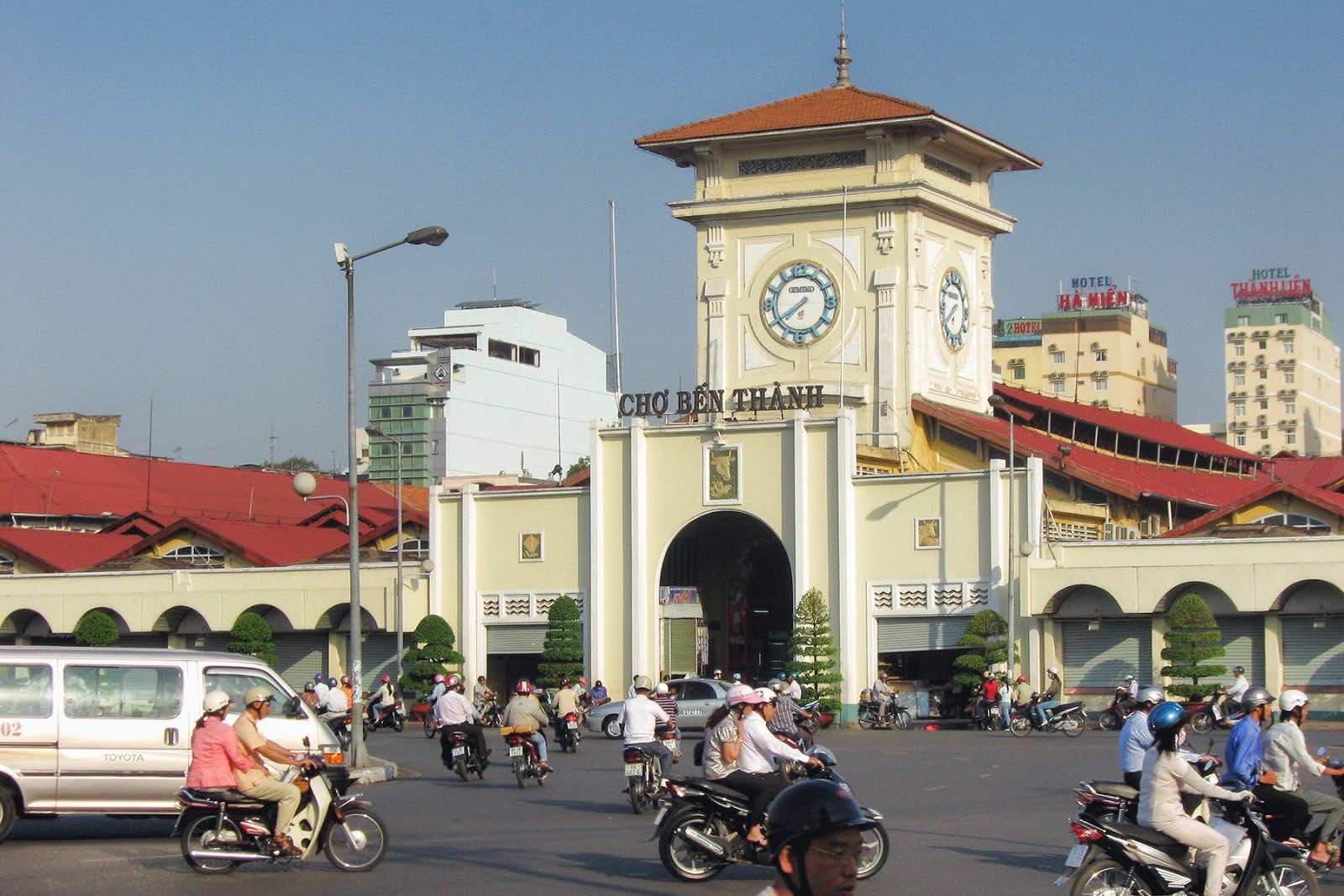
    When you think of Vietnam, you think of pho, banh mi, the nón lá (conical hat symbolic of Vietnam),  the Saigon coffee culture, Ben Thanh Market, the Old Quarter in Hanoi, Ha Long Bay, endless pagodas and encompassing nature, and of course motorbikes. But you’d never really think of the beach, it’s more of a Bali or Thailand or the Philippines thing. And you have never been more wrong. After reading this, you will be acquainted with the top 10 beautiful beaches in Vietnam. 

    With 2,000 miles of coastline and several islands here and there, the best beaches in Vietnam can rival that of its Southeast Asian neighbors. This is why when planning a trip to Vietnam, make sure you do include a beach trip, and if you don’t know which one to visit, this list has the right beach for you in Vietnam.

    Top 10 Beautiful Beaches in Vietnam

    Da Nang

    This 30 km stretch of white sand starts from Monkey Mountain and ends near Hoi An, and is named differently in each area. My Khe is the most popular beach area (being named once as one of Forbes’ World’s Most Luxurious Beaches), with luxury resorts offering an array of spa treatments. But do spend your time on the beach or surf your worries away. And if you do get bored, this place has a lot of non-water activities to offer.

    Hoi An (An Bang Beach)

    Another diamond in the rough, An Bang Beach in Hoi An is known for its quiet waters – swimming and paddle boarding are the best water activities here. It’s not as busy as Phu Quoc nor Nha Trang, but it is very popular with the locals which is why this place can get crowded when it’s vacation season in Vietnam.

    Quy Nhon Beach

    Halfway between Hoi An and Nha Trang, is the laid back but gorgeous Quy Nhon Beach area. Though there is very little tourism in these beaches, it doesn’t mean you shouldn’t visit. If you want privacy and total relaxation, this is where you should go.

    Ninh Chu Beach

    Ninh Chu what? Most of Vietnam enthusiasts might not have heard of Ninh Chu and that this is a beach destination. There is a lot of controversy as to which designated area it falls on the geopolitical map of the country, and the lack of advertising of the hotels and resorts there also contributes to this. But lo and behold, this place is a hidden gem! It has one of the best kite surfing spots in the world, not to mention adventure sports on land including off-roading on dunes! The backdrop to this beach also offers hiking, mountain biking, and rock climbing.

    Doc Let Beach (north of Nha Trang)

    This is by far the best beach getaway in this list. Not only are the waters different shades of clear blue and the sand inexplicably soft and white, the backdrop that this provides for its beaches is also jaw-dropping. It has calm waters which makes it ideal for swimming and several water sports. It has some white dunes, and the best sunrise in Vietnam (great for some Instagram snaps). The shore is also lined with palm trees before the hotels and restaurants greet you and a mountainous backdrop to complete the scenery.  It is halfway between undiscovered and development, so you have the best of both worlds. This place is no doubt one of the best beaches in Vietnam, if not the best one.

    Nha Trang Beach

    Nha Trang, the Riviera of the South China Sea, is one of the more popular destinations and is one of the best beaches in Vietnam. It has a long coastline and is very diverse. You can be in one part which is the center of everything – think busy, tourists everywhere – or on the other side which is quieter, more tranquil. So go here if you want to get a little bit of both.

    Mui Ne Beach

    This place is a unique location because it’s a coastal resort town. A lot of the fishing boats are still resting a few kilometers off the shore, and you can buy some fresh fish off of it if you’d like. It also serves as a nice backdrop when watching from afar. This area is also a known spot for kite surfing, kayaking, and surfing – all thanks to its rock-free waters. It could be crowded at times, but if you choose a nice resort, you could enjoy the privacy.

    Ho Tram Beach (Vung Tau)

    Two things would draw your attention to Ho Tram Beach in Vung Tau. One, it’s close to Ho Chi Minh, only about 110 km away. Imagine just 2 to 3 hours from Ho Chi Minh and you can already jump in the sea. Second, since it’s close to Ho Chi Minh you’d think of it as spoiled and crowded. But no. It still boasts of pristine sands, amazing waters, and a relatively chill vibe. Food won’t be a problem with a variety of restaurants near the shore, not to mention a lot of accommodation to choose from. If you’re in Ho Chi Minh, this is certainly a top choice as one of the best beaches in Vietnam.

    Con Dao Islands

    If you’re yearning for the perfect getaway island, where tourism is relatively low but you have everything you need within a motorbike driving distance, and not to mention rich in history and outdoor activities, then this is the beach for you. Con Dao Island has a lot of beaches, and hotels ranging from budget to luxury, you’d have a grand time here.

    Phu Quoc (Long Beach)

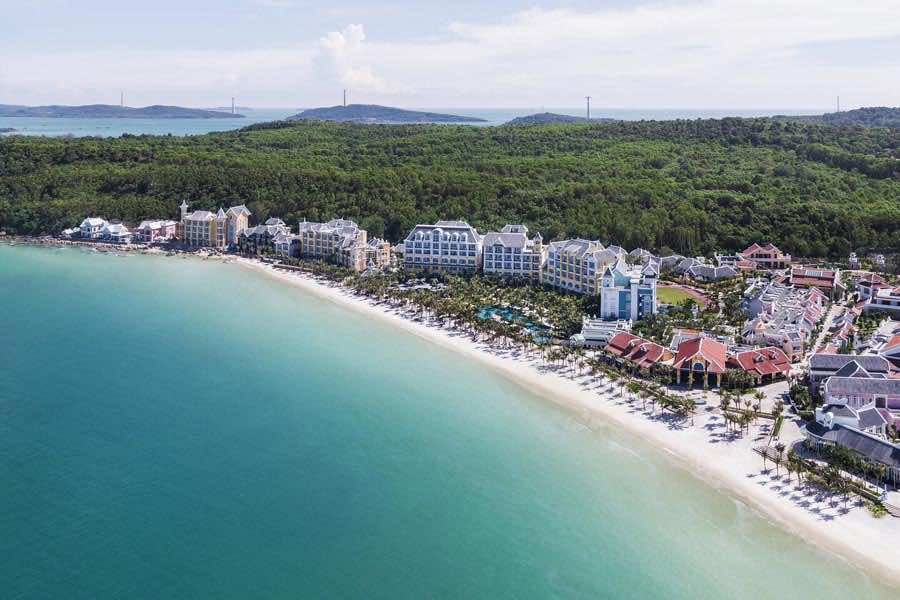
    If hypothetically, Vietnam is to be known for its beach destination, Phu Quoc is what will put it on that list. This island is 45 km west of Ha Tien, which is in southern Vietnam, is popular for a weekend getaway of locals and for travellers longing to get a break from busy Ho Chi Minh or the hot weather in the city. Long beach is named long because of its 20 km stretch of sand. Most of the long beach is private, with luxury resorts claiming the area, but there is still some area considered to be public, especially the stretch near the backpacker street – behind Tran Hung Dao. It’s one of the best beaches in Vietnam with its soft sand and inviting waters.

  • Things to do in Vietnam  – A short guide to main cities

    Things to do in Vietnam – A short guide to main cities

    Things to Do in Vietnam – A Short Guide to Main Cities

    Vietnam, popular for one of the most gruesome wars in the history of mankind, today actively welcomes more than 15 million tourists annually. The ‘S’ shaped country, today dominated by rice fields and motorbikes is incredibly fascinating for the leisure travellers. Be it the street side Bun Cha or the traditional Pho soup, the food here is unrivaled to any Michelin starred. Yes, people come here in search of history, immerse themselves in the undisturbed culture and seek rejuvenation from the hustles and bustles of the Western World.

    Vietnam extraordinarily offers an endless off-beaten exploration path across beautiful metropolises, serene towns and tantalising villages. It might be a mockery for oneself to not visit this country! Wondering about things to do in Vietnam? Well, we have accumulated a concise guide to every major city that this country offers. Check this not so ordinary ‘Things to do in Vietnam’ guide below and treat yourself with some pro-tips and hidden facts which no travel agent will ever tell you!

    Let’s begin with ‘Saigon’:

    When it comes to places in Vietnam, Saigon tops our list. Saigon is like a canvas of modern architecture, medieval culture, and artistic charm. With gravity-defying skyline, Saigon can be enthroned as the most futuristic city in Vietnam! Today, Saigon is known as Ho Chi Minh City, named after a Vietnamese communist leader. Yet, people are still in love with the name ‘Saigon’ and are actively using it.

    Architecture:

    Ho Chi Minh City boasts of a unique fusion of Buddhist and French Architecture. Buddhist Pagodas fuel the holiness of the city in tandem to the beauty driven by Parisian buildings. Visit Vietnam’s version of the prestigious Notre Dame Cathedral in Ho Chi Minh City. If you want to experience local commotion, make sure to pay a visit to China Town Market in the heart of the city! Indeed, it is a paradise for shop-o-holics!

    Nightlife and spectacular places:

    There is no better place than Saigon when it comes to nightlife. Precisely famous for its rooftop bars, Ho Chi Minh is a very open-minded city. These rooftop bars, protruding out of skyscrapers, offer a million-dollar view into the city’s night lights! Savour on some locally brewed drinks or an imported scotch, it’s your choice, but all we have got to say is that the views over the city will leave you in awe! You can also stay at one of the luxury high-rise hotels overlooking vast expanses of this urban civilization.

    Other things to do in Ho Chi Minh City

    Your trip to Vietnam is incomplete without visiting the tropical delta of the majestic Mekong River. There are innumerable boat tours and day trips offered from Ho Chi Minh city which provide a marvellous scenic of the Vietnamese countryside and raw culture. Watch the rice cultivators, wearing Non-La (unique hats) in action. These trips include a visit to the Vinh Trang Pagoda with a traditional lunch.

    Another must-visit destination is the Cu Chi tunnel and underground fortress. For history enthusiasts, this is a perfect day trip away from the commotion of Saigon.

    How about Hanoi?

    Hanoi is the city that you have probably heard the most about. Hanoi is a primary gateway for international flights. Vietjet, Vietnam Airlines, Emirates, Turkish Airlines, tourists have plentiful options to arrive in the country. Be ready to be greeted by subtle urban vibe entangled with the freshness of the greenery.

    Don’t be surprised to see the beautiful lakes hosting the authentic water puppet show! We recommend you to visit one of those and admire a unique experience.

    Food:

     A visit to Hanoi an enriching and sensory experience. Yes, I am referring to the lip-smacking Vietnamese food! Street food dominates the 5-star restaurants, the flavorful Pho soup, Bun Cha and Xoi can easily beat the best Italian dishes! Other delights include the Chinese styled beef jerky, Gou Cuon and Banh Xeo.

    Things to do in Hanoi:

    The most famed Ha Long Bay is a natural wonder in itself. Crazy blue waters, clustered islands and green patches and splendid beaches! All you need for a perfect vacation. Yes, it is worth making a day trip to Halong Bay from Hanoi. You can take a multiday cruise and admire the Vietnamese luxury!

    Besides, the city of Hanoi offers a variety of different activities. Biking trips are very common, as well as food tours are a norm for solo and group travellers.

    Now the most fascinating part comes here

    Cities in Vietnam are diverse and different. But, at the same time, they are joined by this thread called ‘motorbikes’. Yes, Vietnam has an extraordinary number of motorbikes, wiggling in every direction regardless of which part of the country you are in. This acts as a lifeline for the locals, but equally, they are of fascination for western tourists. Motorbikes are now deeply ingrained in Vietnamese culture and give an insight into a unique culture to the tourists. The miraculous number of these automobiles, do create some commotion, but after even this commotion is part and parcel of tourist experiences.

    Secondly, we cannot ignore the Vietnamese Dong, an overwhelmingly undervalued affair, offering just too many affordable things at low prices for western tourists.

    Nonetheless, Vietnam is adjourned with real jewels, bringing culture, heritage, and modernization together. Next time when you plan a trip to Paris or Newyork, just think about countries like Vietnam for a moment. They do exist, and they have an unparalleled charm!

    What if you are on a budget?

    Vietnam has been fascinating solo travelers and backpackers with its pocket-friendly currency ‘dong’. [T2] One can fetch things for a miniscule amount when in Vietnamese cities. For budget travelers, Vietnam offers a wide range of things to do, when on a budget. Did you know that one dollar in Vietnam can fetch you a full-fledged scrumptious meal?

    Moreover, there are various tours offered tailored for backpackers! For example – The 4am food tour offered for early risers and foodies on a budget! To sum it all, Vietnam can be a heaven for both budget travelers.

  • All You Need to Know about 4×4 Self-Drive Tours in Vietnam

    All You Need to Know about 4×4 Self-Drive Tours in Vietnam

    Vietnam is studded with incredible gems that every traveller admires. Enchanting cities, the finesse of East Asian culture and it’s bond with nature undeniably exotic to the core. Be it the coffee plantations rolling over the hills or the rice fields and valleys intersecting small villages, we are sure Vietnam will not fail to impress you. Tourists often ask which is the best way to explore Vietnam, and with utmost pride, we have a definite answer. Of course, we are referring to 4 wheel drives, which tops our charts in one of the most unique ways to explore this beautiful country. Tourists usually flock to the Hanoi and Saigon and as a result, they miss the pristine beauty that Vietnam offers. Through this article, we would like to share with you how you can enjoy Vietnam through a 4×4 drive tour.

    Let us introduce you to the nitty-gritty of taking such a trip across the countryside.

    Where are these tours in Vietnam conducted?

    These tours in Vietnam are multiday itineraries originating from different places. There are several loops that are operated. Major routes are as follows:

    – North West Loop
    – North East Loop
    – Central Highlands
    – Northern Loop
    -Coastal Route
    -International Route

    These routes will be discussed in further detail below.

    What vehicles are used for these tours?

    These tours are purely conducted on a 4 wheel drive basis. Trucks such as Colorado, Isuzu, Toyota, Ford Ranger, Chervolet and Dmax. These vehicles are well maintained, clean, and undergo frequent checks, in order to ensure that tourists have an uninterrupted experience. Typically, one vehicle can accommodate 5 people. However, only 3 tourists can sit since the driver and the tour guide need to be accommodated as well.

    Where do these tours start and end?

    Typically, these tours the same departure and arrival locations. They usually start and end from major cities like Hanoi and Saigon.

    How are all the practicalities dealt with during the 4×4 self-drive tour in Vietnam?

    Practical arrangements mainly comprise of lodging and food. 4×4 tours in Vietnam are associated with starred hotels, decent guesthouses, and friendly homestays. At no point in time during your trip, you will ever be disappointed with the accommodation. These lodging arrangements are usually provided on double sharing basis, but certain expectations can be made depending on availability.

    As far as food is concerned, local food is abundantly available everywhere. The dinners are memorable and breakfast is surplus for your needs.  The lunch is never included in the packages and tourists are free to choose what they want to eat from local restaurants.

    What is the specialty of 4×4 tours in Vietnam?

    As mentioned above, Vietnam hosts a huge range of natural wonders. Be it lakes, hills, fields or the gorgeous valleys, tourists enjoy these sites. 4×4 tours are curated to cover these natural highlights. They are designed to give urban tourists a new perspective about Vietnamese culture and off-beat travel. Each of the routes mentioned above has a specialty.

    North-west loop: The North-west loop is a mountainous stretch of land stretching from Hanoi, all the way to Ban Ho and Sa Pa. It involves a jolting drive across the hilly terrain through many passes, terraced rice fields, and valleys.

    North-east loop: The North Eastern loop is hilly as well. It is less explored, hence less exploited. Comprising of lakes, viewpoints, and the scenic locations, this is the perfect route for photography enthusiasts. Get ready to drench in the waterfalls.

    Northern Loop: The Northern Loop is an amalgamation of both North Western and North Eastern Circuits. It takes at least 13 days to complete this tour and is great for travellers who wish to explore different subcultures within Vietnam.

    Central Highlands: A volcanic lake, a battlefield, and wooden churches there is a lot of diverse things to see in the Central Highlands. From Pagodas to rivers don’t be shocked to cover a wide range of things during this tour.

    Coastal Route: Undoubtedly, the coastal route in Vietnam is nothing less than a paradise for water lovers. This tour is a mix of recreation and adventure along the coasts and bays of Vietnam. You can take boat trips to a nearby island, or decide to relax in the comfort of your hotel.

    International Route: What is better than crossing boundaries aboard a 4×4. Travel across Vietnam and Laos and get to know about two countries, two distinct landscapes and a multitude of cultures.

    Self Drive vs with Driver, which is a better option?

    Both options are actively available to tourists. Foreigners cannot drive a vehicle in Vietnam unless they have an International Driving Permit. Modern navigation systems have made it possible to conduct a self-driving tour without any hassles. However, we would still recommend you to hire a driver since traffic in Vietnam highly disorganised and it can be difficult for some drivers hailing from western countries to adapt. The hilly regions can be dangerous to drive due to unexpected turns and low visibility.

    How much do these tours cost?

    It depends on routes, level of accommodation, trip length as well as chosen 4×4 vehicle for your tour.

    How to book these tours?

    We provide our guests with a full-fledged booking channel. Through us, you can be assured of the best rates. Click the Enquiry form and your personal travel consultant will get back within 12 hours.

    BONUS! Know about exclusive motorbike tours

    4×4 rides have their charm, but riding a motorbike in Vietnam is surely a unique experience. These tours take place on the same routes, but offer a completely different experience. Submerge yourself in the Vietnamese landscape by taking one of the motorbike tours.

  • Muong Hoa Valley Sapa, Vietnam

    Muong Hoa Valley Sapa, Vietnam

    Muong Hoa Valley Sapa, Vietnam

    Muong Hoa Valley Sapa, Vietnam, is a charming tourist area with high ratings for locals and visitors. The scene is attractive and loaded with natural beauty. There are unique terraces that makes the spectacular landscape.

    Alongside the hospitable, warm, and friendly people, the Muong Hoa Valley offers tourists a long-lasting experience. Here, you explore everything about this spectacular valley and why it’s one of the leading attractions for visitors in Vietnam. Keep reading.

    Getting around in Sapa

    While exploring the Muong Hoa Valley, one can get lost in this breathtaking landscape. It’s one of the beautiful places of the planet that the creator must have spent time designing. With a wide forest cover entrenching the area, tourists will need a local guide to get their way around.

    The Muong Hoa valley is located 10km southeast of Sapa town. Visiting the Muong Hoa Valley will allow you to witness the Hoa stream that stretches 15km through other smaller versions such as Hau Thao, Lao Chai, Ta Van, and ends at the poetic Ban Ho village.

    Your vision will get immersed in the curvy streams that hug the slopes. Here, there are rice terraces, and you’ll be lucky to visit the valley when rice is ripe. The fields are yellow, with blue waters from the streams bringing out an unforgettable spectacle.

    You can get to Sapa by train. While in Vietnam, you can take a train from Hanoi, which is safe and comfortable. There are several agencies where you can book tickets for your journey. Alternatively, you can book at the station. Normally, it’s advisable to book early to ensure you secure a seat.

    Several train companies operate the route, such as the Chapa Express, Fansipan Express, King Express and the Victoria Sapa Express.

    Other options are taking a sleeping bus, shuttle limo or a private car. Although there are buses, motorbikes, or taxis to get you around Sapa, trekking is more refreshing and lets you have a better view of the scenery.

    Trekking around will require local contact with wide knowledge about the land, cuisine, culture, shortcuts, and more. By hiking around, you’ll get to witness several villages and their traditional handicrafts. You can go to Sapa at any time of the year and but summer is livelier and mesmerizing.

    Things to do in Sapa

    Exploring Sapa by foot will allow you to sample what it has offered. During your visit, you can promote the local community by buying their handicrafts. One notable aspect of Sapa is that the local communities have lots of things to sell, and these range from bracelets, headbands, jewelry, shoes, scarves, anklets, and more.

    What sets these items apart is the different patterns, texture, and colors. These are antiques that present different communities in Sapa. By buying these items, you get to interact with the locals and learn more about their culture.

    Other than that, the Sapa market has everything with so many sellers displaying their products. Therefore, a visit here is surely going to yield a lot.

    Another activity is riding around with a motorbike. Although tour companies have good offers and can take you anywhere, a bike offers a more relaxing ride. The motorcycles don’t Over speed, and you can get to visit several places while admiring the stunning landscape on valleys. You also have the opportunity to stop and take photos of the scenery.

    Sapa has a lot of terrains for visitors to explore.  If you love mountain trekking, then you’d want to tackle the Fansipan, which is the tallest mountain in Vietnam.

    Conquering the Fansipan Mountain is yet an incredible activity worth of your time and the most memorable. However, you need a guide to take you around. In this case, we recommend visitors book with any of the tour agencies in Sapa. They will take you to the mountain peak of Mt. Fansipan, and from here, you can have a great view of the ground below.

    A visit to Sapa will be complete with a walk to the Muong Hoa Valley. You will get to appreciate the natural beauty, and luckily, there are village guest houses where you can book night after a long trek. Some agencies can facilitate your visit, and the local people also incredibly helpful.

    The trek is incredible since you can walk through the terraces and drink water from the streams. Additionally, you get to sleep on traditional mates and hang with the locals. Rice wine is refreshing and something you can try before you call it a day.

    Sapa town has modern hotels with a touch of tradition. The town is buzzing with activities as locals put up hotels in every space. As a foreigner, you’ll want to taste the local cuisine and get to interact with the people.

    Sapa Rice Terrace Fields, Vietnam

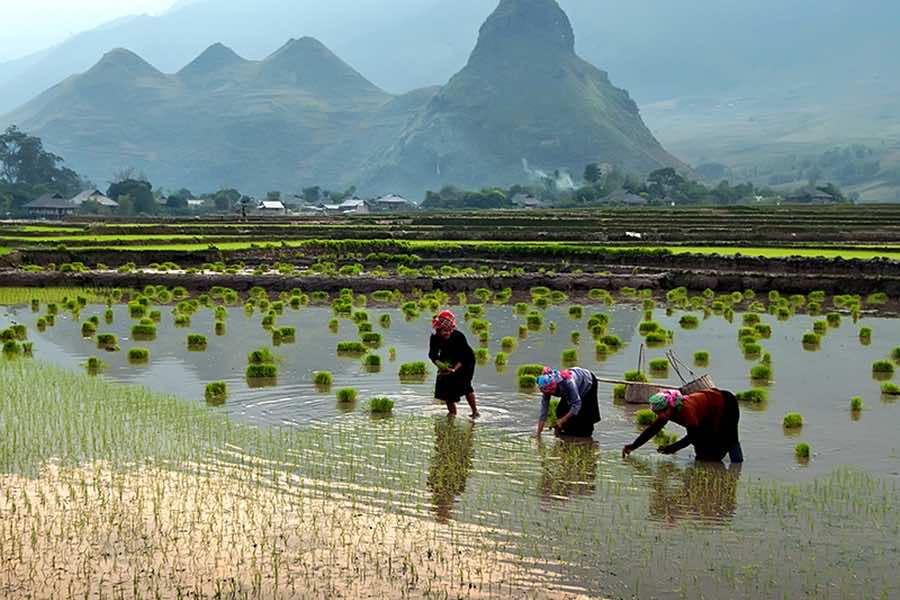
    Around the world, rice grows in open fields but not with Sapa. The Sapa rice terrace fields in Vietnam are some of the world wonders where rice grows in terraces along the mountain. The area is steep and fertile with nutrients from the granite rocks.

    The locals grow the rice on the terraces from the roof to the bottom of the mountain. The area is picturesque with eye-catching beauty that attracts tourists to the area. It’s even more charming during summer when rice is growing, and the area has a blend of green and yellow vegetation.

    April and May are busy months as the locals prepare the fields to plant. The area is a field with terraces of red soil and forested trees on the background.

    In June and July, the terraces now have grown rice, and the trees surround the landscape. In late August and early September, its autumn and rice are ripe with golden color.

    Muong Hoa Valley Villages 

    Several guest villages in Muong Hoa Valley are accessible mainly by foot, bikes, or small cars due to the narrow paths. It’s here that visitors take a rest, have lunch, interact with the locals, and spend the night after a long trek of the Muong Hoa Valley.

    The trip to these villages allows you to enjoy the spectacular view of the terraced field. A trek to the villages will take you through the waterfall, narrow stream, and hydroelectric station.

    • Cat Cat village

    Cat Cat village rests at the base of Muong Hoa Valley and is close to Sapa town. It is easy to get to the village, and you can trek without the help of a tour guide. It’s only three kilometers from Sapa town and has a rich history of the local customs and traditions.

    The road trip to Cat Cat village is poetic as you view the valleys and the mountains. You can take a bike, bus, taxi, or simply trek downhill.

    For accommodation, there are village homestays where you interact with the villagers and learn about their culture. In the village, you’ll view the rice fields which change color depending on the season.

    Also, you can buy local costumes, visit the rose garden, and buy traditional crafts. You also get to watch the traditional dances and relax by the waterfalls.

    • Lao Chai village

    Loa Chai village is further at 6km from the Sapa town. It’s the best place to view the imposing landscape and is bustling with life. Here you get to explore a lot in terms of diversity and culture of local people.

    You can feel the warmth since the people are friendly and ready to interact with the guests.  Trekking to the village allows you to witness firsthand the picturesque terrain and the beauty of Sapa.

    • Ta Van Village

    Ta Van is a tiny village situated 10km for Sapa town. It offers a good view of the landscape, and as a neighboring village, you wouldn’t want to miss a visit here.

    There are lots of activities to indulge in while at Ta Van village. First, the location lets you have a glimpse of the rice fields and the local people as they go on their daily activities. Everything here seems to be slow, and the food is delicious.

    There are many routes and paths around the village, and its recommended to get a local guide. Also, it can get muddy during the rainy season, and you’ll need hiking boots and bamboo sticks.

    • Y Linh Ho Village

    Y Linh Ho village is situated 7km southwest of Sapa town and is a good place to view the terraced rice fields. A trek to the Y Linh Ho village is fulfilling, and the neighborhood is warm and welcoming.

    The local people help visitors learn about the culture and customs. There are many activities that they engage in, such as textiles and weaving fabric. Tourists often promote the local community by buying their crafts.

    Despite the friendliness of the people, treks will be the highlight of your tour. You’ll be mesmerized, walking down the valleys and breathing fresh air.

    • Ban Ho Village

    Ban ho village is further and is 30km from the Sapa town which is less visited by tour groups.

    Ban ho village is a popular overnight stay place for travelers making 3-day trek along Muong Hoa Valley. If you’re planning to explore the villages, this place is a must on your list.  Its the home to several local communities and there’s every reason to visit the village. For starters, it’s warmer than the other villages in Sapa, and you can visit the place any time of the year.

    Secondly, the people are friendly, which gives you the chance to learn about their way of life. Trekking to the village lets you explore the village and experience nature in its purest form. There are houses scattered everywhere, and the small rivers flowing visit one to remember.

    While at the village, you’ll also participate in festivals, which will be fascinating. There is the Ban Ho center, and here is the concept of homestay is much alive.

    Sapa Trekking Tours (1 day, two days, three days)

    Some of your best memories of a trip to Sapa will be trekking through the rice field terraces for 1,2 or 3 days. Thankfully several tour guides facilitate the trekking.

    The tours are incredible, and you get to enjoy the view of the valley without the worry about missing anything. In the tours, you’d get to trek up the mountains and down as you discover the traditional villages.

    These offer an incredible experience, and you get to interact with the locals and learn about their customs and culture. The tours also give an adventure of the rice terraces, depending on the time of the year.

    A 1, 2, and 3 tours also give you the chance to walk around and enjoy the food and other delicacies. A local guide is more focused and will answer any of your concerns.

    Sapa Trekking Map

    The Sapa map us like a spider web that features the entire area. There are many trekking routes and feeder roads. During your visit, you can use the map to mark the routes. A tourist map shows all the areas to visit and is the best for orientation. Although you can get yourself a local guide, a Sapa map gives you a clue about specific areas to explore either by foot, small car, or motorbike.

    Muong Hoa Valley without a guide

    Although visitors need a local contact during their tour of Muong Hoa Valley, here are some safe areas which are accessible without a guide. For instance, the Cat Cat Village has proximity to the Sapa town. However, climbing Fansipan requires an experienced guide.

    The roads are many, and one can easily get lost. Luckily there are Sapa trekking maps which you can pick from your travel agency and which you can follow.

    Muong Hoa Valley entrance fee

    The good news you don’t have to pay anything to access the Muong Hoa Valley. There are no charges whatever. However, you’ll incur the entrance fee if you visit villages and the cost is between US$2-3 per route.

    Best time to visit Sapa

    Sapa has different seasons and can get cold and even snowy during winter. The rainy season is between July and August and winter December and January.

    The best time to visit Sapa is between March and June and October to early December. Between August and September, the fields are a blend of golden rice for harvesting and a background consisting of forested trees that is one of the best times to hunt for perfect shots of the golden rice terrace fields and daily lives of the hill tribe living around Sapa.